Get 5% Off your first order! Use Code : MEWAMITRA5
Free Flavoured Cashews on Orders Above ₹2999
🚚 Free Shipping on Orders Above ₹799 | Shop Now & Save More!
Mewa Mitra Royal Combo – ₹1,392 | Premium Dry Fruits
Mewa Mitra Signature Combo – ₹1172 | Best Seller
Mewa Mitra Classic Combo – ₹888 | Value Pack
Mewa Mitra Elite Combo – ₹489 | Value Pack
Get 5% Off your first order! Use Code : MEWAMITRA5
Free Flavoured Cashews on Orders Above ₹2999
🚚 Free Shipping on Orders Above ₹799 | Shop Now & Save More!
Mewa Mitra Royal Combo – ₹1,392 | Premium Dry Fruits
Mewa Mitra Signature Combo – ₹1172 | Best Seller
Mewa Mitra Classic Combo – ₹888 | Value Pack
Mewa Mitra Elite Combo – ₹489 | Value Pack


The Raw Cashew Grading Guide: W180 to W450 Explained

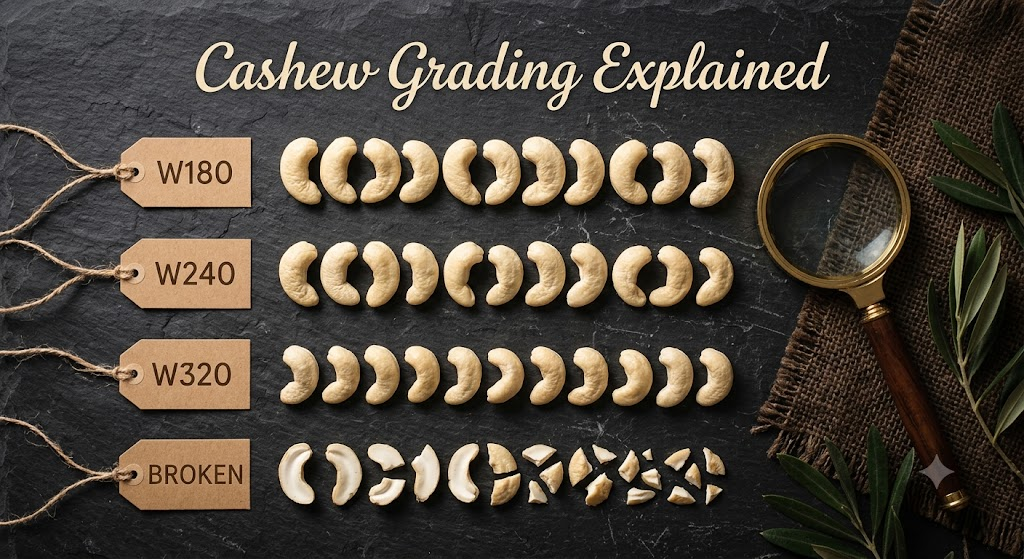
Have you ever looked at two packs of cashews and wondered why one costs much more than the other?
Both may look similar at first. Both are labelled as cashews, both may be sold in similar quantities, and yet there can be a noticeable difference in price.
The reason often comes down to cashew grading.
Once you understand what codes such as W180, W240 and W320 mean, buying kaju becomes much easier. You can understand what you are paying for, choose the right size for your purpose and avoid spending extra money on a grade you may not actually need.
At Mewa Mitra, we come from a trading family with more than seven decades of experience in commodities, so cashew grading is something we have seen and discussed throughout the trade.
In this guide, we will explain raw cashew grading in simple terms, including whole grades, broken cashews, quality checks and which grade makes sense for different uses.
How Does a Cashew Become Kaju?
Before talking about grades, it helps to understand where the finished cashew kernel comes from.
Cashews grow at the bottom of the cashew apple, inside a hard outer shell. After harvesting, the raw cashew nuts go through processing to remove the shell and release the edible kernel.
The kernel is then peeled and dried before being sorted.
This is where grading comes in.
Cashews are separated based on factors such as:
- Size
- Shape
- Colour
- Whether the kernel is whole or broken
- Visible defects
The result is a range of grades that help buyers understand what they are getting.
What Does the “W” in W320 or W240 Mean?
The W generally stands for White Whole.
In simple terms, it refers to whole cashew kernels that are white to ivory in appearance.
The number indicates the approximate number of whole kernels per pound, traditionally based on about 454 grams.
This gives you an easy rule to remember:
Smaller number = larger cashew.
So:
W180 is larger than W240, and W240 is larger than W320.
Likewise, W320 is larger than W400 or W450.
This is why a W180 pack can be more expensive than a W320 pack even though both contain whole cashews.
The Most Common Cashew Grades Explained
W180
W180 is one of the larger commonly traded whole cashew grades.
The kernels are large, plump and visually impressive, which makes them particularly suitable for premium presentation and gifting.
If appearance and size are important, W180 is a grade worth considering.
W210
W210 is slightly smaller than W180 but is still considered a large and attractive whole kernel.
It is often chosen when buyers want a premium-looking cashew without necessarily going for the largest available size.
W240
W240 sits between the larger premium grades and the more commonly used medium-sized grades.
It offers a good combination of size, appearance and value.
For people who want larger-looking cashews for snacking or serving guests, W240 can be a practical choice.
W320
W320 is one of the most widely used whole cashew grades.
The kernels are medium-sized and work well for everyday snacking, cooking and sweets.
They are also easy to use in households because you get whole kernels without paying the premium associated with the very largest grades.
For everyday use, a good-quality W320 can be a very practical choice.
You can explore Mewa Mitra’s cashew collection to see the available options.
W400 and W450
These grades contain smaller whole kernels compared with W180, W210, W240 and W320.
They can make sense when size and presentation are less important.
For example, if you are using cashews in a curry, grinding them into a paste or adding them to a recipe, paying extra for very large kernels may not provide much practical benefit.
A Simple Cashew Size Chart
| Grade | Relative Size | Common Use |
|---|---|---|
| W180 | Very large | Premium gifting, presentation |
| W210 | Large | Gifting, serving, premium use |
| W240 | Medium-large | Snacking, serving, cooking |
| W320 | Medium | Everyday snacking, sweets, cooking |
| W400 | Smaller | Cooking, grinding, recipes |
| W450 | Smaller | Cooking and value-focused use |
The exact appearance and commercial specifications can vary between lots and suppliers, so the grade should be treated as a guide rather than a guarantee of every quality characteristic.
What Are Broken Cashew Grades?
Not every cashew kernel comes out of processing perfectly whole.
Some kernels naturally break during shelling, peeling, handling or processing. These are sorted separately rather than being discarded.
You may come across terms such as:
Splits
Splits are kernels that have separated into two relatively large pieces.
They can be useful for cooking and recipes where the whole-kernel appearance is not important.
Butts
Butts are broken portions of the kernel, generally separated across the middle.
They can be used in sweets, cooking and other preparations.
Pieces
Pieces are smaller fragments of cashew kernel.
They are particularly useful when the cashews will be:
- Ground into a paste
- Blended into sweets
- Added to gravies
- Mixed into cakes
- Used in desserts
- Chopped into recipes
One important point is that broken does not automatically mean bad.
A broken cashew can still have the same basic nutritional value and flavour as a whole kernel. The main difference is appearance and size.
That is why pieces and splits can be a smart choice when you are cooking rather than gifting.
Explore Mewa Mitra’s broken cashews and cashew options for practical kitchen use.
Other Cashew Terms You May Come Across
Cashew grading can involve more than just W180 or W320.
You may also see terms used to describe kernels with differences in colour, appearance or minor defects.
For example, some trade classifications include scorched wholes, where the kernels have some browning, and other classifications for kernels with minor colour or surface imperfections.
These kernels may not have the same visual appeal as bright, uniform white wholes, but they can still be useful for cooking and processing.
The important thing is to understand what you are buying rather than assuming that every difference in appearance means a major difference in taste or nutrition.
Does Cashew Grade Change Its Nutrition?
Generally, the grade itself is not what determines the nutritional value of a cashew.
A larger W180 kernel and a smaller W320 kernel are both cashew kernels. If you compare them by weight, their basic nutritional profile is broadly similar.
What you are generally paying more for with larger whole grades is:
- Larger kernel size
- Uniform appearance
- Whole-kernel presentation
- Lower levels of visible defects
- Better visual appeal for gifting or serving
So, W180 is not automatically healthier than W320.
If nutrition is your main concern, choosing a fresh, good-quality cashew and keeping your portion sensible matters more than simply choosing the largest grade.
For more information, read our guide to the health benefits of cashews.
Which Cashew Grade Should You Choose?
There is no single “best” cashew grade.
The right choice depends on what you plan to do with it.
For Daily Snacking
W320 is a practical everyday option. W240 is also worth considering if you prefer a somewhat larger kernel.
For Premium Gifting
Larger grades such as W180 and W210 can create a more premium visual impression in a gift box.
For Serving Guests
W240 or W210 can work well when you want attractive whole kernels on the table.
For Cooking
W320 and smaller whole grades can be practical.
For Gravies and Cashew Paste
Broken pieces and splits can be more economical because the appearance of the kernel does not matter once it is ground.
For Kaju Katli
Pieces and splits can work very well because the cashews are ultimately ground into a paste.
There is little reason to pay a premium purely for whole-kernel appearance when the final recipe will grind the cashews anyway.
How to Identify Good-Quality Cashews at Home
A grade code tells you about size and type, but it does not tell you everything about freshness.
When you receive your cashews, use these simple checks.
1. Look at the Colour
Fresh whole cashews are generally creamy white to light ivory.
Some natural variation is normal, but unusually dark, grey or discoloured kernels deserve closer inspection.
2. Check the Smell
Fresh cashews have a mild, pleasant nutty aroma.
If they smell strongly oily, sharp, stale or paint-like, they may have developed rancidity.
3. Check the Texture
A good cashew should generally have a firm, crisp texture.
If it feels unusually soft, rubbery or chewy, moisture may have affected the product.
4. Taste a Small Amount
Fresh cashews generally have a mild, creamy and slightly sweet flavour.
A strong bitter or stale taste can be a sign that the product is no longer fresh.
5. Check for Cleanliness
Look for clean kernels without:
- Insects
- Webbing
- Excessive dust
- Shell fragments
- Unusual foreign material
Also check the packing date and best-before information on packaged products.
Why Grade Is Only One Part of Cashew Quality
This is one of the most important things to understand when buying kaju.
A grade such as W320 tells you about the size and whole-kernel classification. It does not tell you everything about freshness, storage or handling.
Imagine two W320 cashews.
One was recently packed, stored properly and kept in an airtight package.
The other has been sitting exposed to heat and humidity for a long time.
They may carry the same grade, but the eating experience can be very different.
That is why we recommend looking beyond the grade and considering:
- Freshness
- Packing date
- Storage conditions
- Packaging quality
- Cleanliness
- Seller transparency
For a broader buying checklist, read our guide on how to choose the best cashew nuts brand.
How to Store Cashews Properly
Even good-quality cashews can lose their freshness if they are stored incorrectly.
At home:
- Keep them in an airtight container.
- Store them in a cool, dry place.
- Keep them away from direct sunlight.
- Avoid storing them next to strongly scented spices.
- Always use a clean, dry spoon.
- In hot or humid conditions, refrigeration can help extend freshness.
If you refrigerate cashews, make sure the container is properly sealed so that moisture and food odours do not affect them.
What About Roasted and Flavoured Cashews?
Roasted cashews usually begin with the same types of whole or broken kernels discussed above.
The difference comes from what happens afterward.
They may be:
- Dry roasted
- Oil roasted
- Salted
- Spiced
- Flavoured
- Coated
The grade still matters, but preparation becomes another part of the buying decision.
If you enjoy flavoured kaju, read our guide comparing flavoured and plain roasted cashews before choosing a product.
Cashew Grading for Gifting and Bulk Buying
If you are buying cashews for personal use, grade mainly helps you decide what size and value make sense.
For gifting, appearance becomes more important.
Large, whole kernels such as W180 and W210 can look particularly attractive in premium gift boxes.
For bulk buyers such as sweet shops, caterers and food businesses, the priorities can be different. Pieces and splits may be preferred for recipes because they offer a practical way to manage ingredient costs without needing whole kernels.
If you are buying cashews in larger quantities for a business or event, you can contact Mewa Mitra to discuss your requirement.
For festive gifting, explore our guide to premium kaju gift boxes.
Frequently Asked Questions
What does W320 mean in cashews?
W320 refers to a white whole cashew grade. The number is based on the approximate count of whole kernels per pound, so W320 is smaller than grades such as W240 and W180.
Is W180 better than W320?
W180 is larger than W320, but “better” depends on what you need. W180 can make more sense for premium presentation, while W320 can be a practical choice for everyday eating and cooking.
Are broken cashews lower quality?
Not necessarily. Broken cashews are mainly different in appearance and size. They can still have the characteristic flavour and nutritional value of cashew kernels and are particularly useful for cooking, grinding and sweets.
Which cashew grade is best for kaju katli?
Pieces and splits can work very well for kaju katli because the cashews are ground before preparation. There is usually no need to pay a premium simply for whole-kernel appearance.
Which cashew grade is best for daily snacking?
W320 is a popular practical choice for everyday snacking. W240 can be a good option if you prefer larger kernels.
Which cashew grade is best for gifting?
Larger whole grades such as W180 and W210 are often chosen when visual presentation is important.
Does a higher cashew grade mean better nutrition?
Not necessarily. The grade primarily describes size and whole-kernel classification. A larger grade is not automatically healthier.
How can I identify fresh cashews?
Look for clean, creamy-coloured kernels with a mild nutty aroma and a firm, crisp texture. Avoid cashews with a strong stale or paint-like smell, unusual softness or an unpleasant bitter taste.
Final Thoughts
Cashew grading may look complicated when you first see codes such as W180, W210, W240 and W320 on a pack.
But the basic idea is quite simple:
The smaller the number, the larger the whole cashew kernel.
From there, your choice depends on what you need.
For everyday snacking, W320 can be a practical option. For a larger, more premium-looking kernel, you can consider W240, W210 or W180. And when you are making sweets, gravies or cashew paste, broken pieces and splits can offer excellent practical value.
Most importantly, do not judge a cashew only by its grade. Freshness, storage, cleanliness and packaging matter too.
Once you understand the grading system, buying kaju becomes much less confusing.


 Almonds
 Cashew
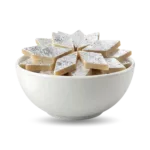 Kaju Katli
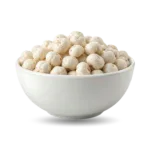 Makhana
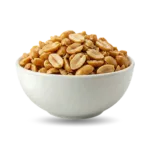 Peanuts
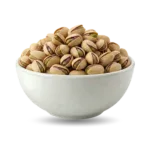 Pistachios
 Raisins
 Seeds
Seeds Walnuts